What tacit knowledge leaves with a retiree
After my first session at the Hudson Valley Future Summit, a woman came up to me with questions. I'll call her Marian (a pseudonym).
She'd worked at the university for thirty years. Over that time she'd taken on many different roles and filled in for many different people. Everyone still came to her with their questions. Her questions for me came down to this: how can I get my knowledge, my tacit knowledge, into a system? I have so much information. How do I share it before I leave?
This is my longer answer.
What stays and what leaves
When someone like Marian leaves, a lot stays behind. The job descriptions stay. The org chart stays. The policy manuals and the systems' user guides stay.
What leaves is the kind of thing nobody writes down. Why a process runs in the order it does. Which person needs a call and not an email. The workaround that keeps two systems in step. Who to call when a report looks wrong.
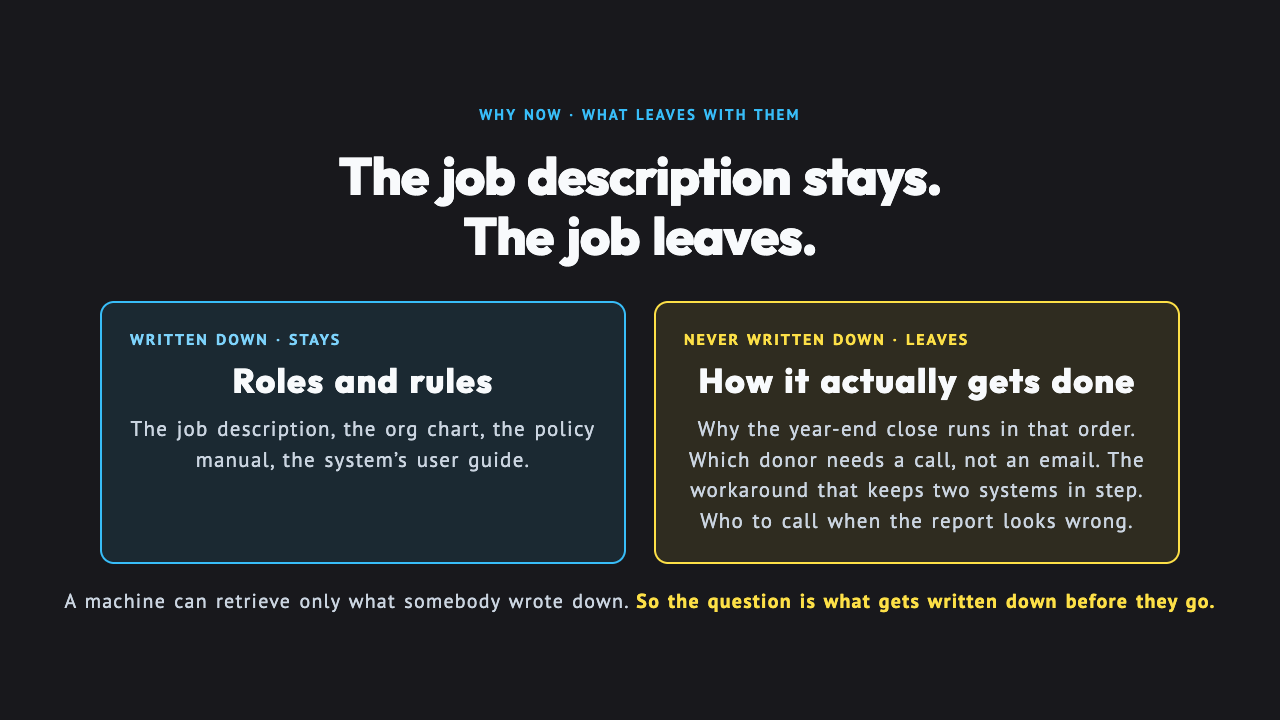
None of that is in any system. For thirty years it didn't need to be, because people asked Marian.
Every retirement is a tacit knowledge transfer problem, and most organizations aren't solving it. In a 2025 APQC survey, "92% of organizations do not consistently capture knowledge from soon-to-be retirees" (APQC, 2025). One survey of U.S. workers estimated that "42 percent of institutional knowledge is unique to the individual" (Panopto, 2018).
"I have so much information"
Marian's worry was how much information she had. I don't think the amount is the hard part.
Information is the part that's easy to hand over: the files, the records, the documents she wrote. Knowledge is something else. Russell Ackoff called it "know-how, for example, how a system works" (Ackoff, 1989, p. 4, as cited in Frické, 2009).
I explain it with an iceberg. The small white tip above the waterline is what gets written down. Everything below the waterline is what people actually carry: the workarounds, the handoffs, the judgment calls, the guiding principles, the tacit knowledge. Most of what Marian carries is below the waterline.
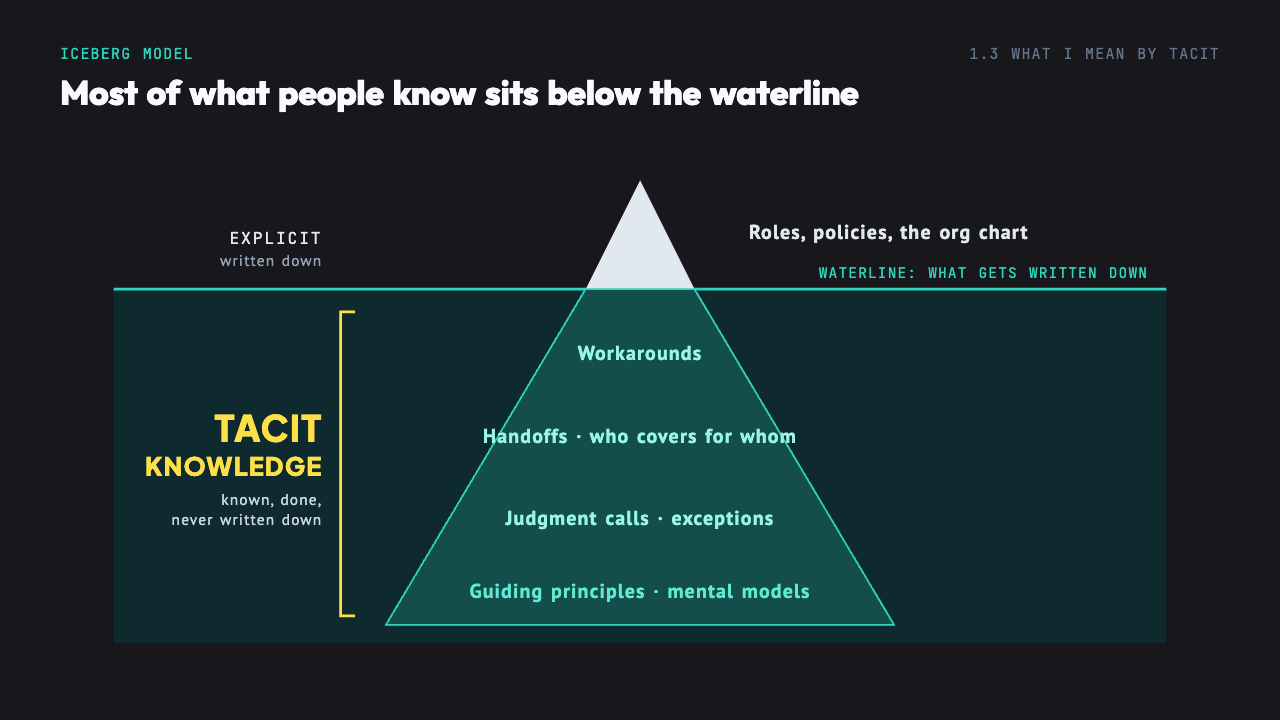
And she can't simply sit down and write it out. Edward Feigenbaum saw this in 1977, building some of the first expert systems. The expert, he wrote, "knows more than he is aware of knowing" (Feigenbaum, 1977, p. 1017). That isn't a failing on her part. It's how expertise works.
Why the usual answer falls short
The usual answer is a handover document, a wiki page, or a few weeks spent writing it all up. Knowledge management has been offering versions of that for three decades. Back in 1988 the promise was that information systems would "maintain the corporate history, experience and expertise that long-term employees now hold" (Applegate et al., 1988, as cited in Malhotra, 2004). Most of us have since built knowledge systems that nobody uses. I've built one myself.
Those systems were filled from the top down, with documents. What Marian knows doesn't come out that way.
A ground-up audit of one person
What I'd suggest is a knowledge audit that starts with her and what she knows. A knowledge audit asks what an organization knows, what it needs to know, where that knowledge lives and where it breaks. The idea has been around knowledge management for at least twenty-five years (Liebowitz et al., 2000). A ground-up audit starts with the person doing the work, not with the documents.
For one person, it looks like this:
- 1x1 listening sessions, recorded and transcribed, on a regular rhythm. Start months before she leaves, not in her last week. Take one role at a time, and one person she covered for at a time.
- A short record of each workflow, in her own words, linked to the moment she said it.
- Her review. She reads her records and fixes anything that isn't accurate. Seeing it written down brings out the steps she'd never have volunteered in conversation.
- An owner for each record, someone who'll keep it current after she's gone.
This is where qualitative AI analysis helps. Interviews have always been the expensive part of a knowledge audit. Patrick Lambe's survey of knowledge auditors found interviews valued "for their depth and richness," and also "time consuming to conduct and analyse" (Lambe, 2017). Now an hour of conversation becomes a transcript in minutes, and agents can do much of the tedium: pulling quotes, proposing patterns, drafting the records.
They also miss things. In one study of a model analyzing interviews, it never surfaced themes that "clearly had value for human analysts" (De Paoli, 2024, p. 19). So the agents stay behind us, not in front of us. Marian decides what's accurate.
A vault for the right person, at the right time
What comes out goes into a knowledge vault: plain text files, an index, and a short page telling the AI what to read first.
Marian's vault doesn't need many users. It might be opened by one or two people, whoever takes over each of her roles, at the moment they need it. That's the measure. Not how many people use a vault, but whether it gets used at the right time, when the knowledge is needed most. Some of it should only reach that successor. Proper access matters more than wide access.
For thirty years, the people who came to her with questions were being onboarded and cross-trained, one question at a time. A vault lets that go on after she leaves. A new person can ask it in their own words, in their own order. Writing in Harvard Business Review this fall, Kris Johnson Ferreira and Jordan Tong note that most companies "still struggle to apply [AI] to the cross-functional work that makes or breaks enterprise performance" (Ferreira & Tong, 2026). Someone who has filled in across many roles holds exactly that cross-functional knowledge.
Before she leaves, there's one more step. Marian asks the vault the questions her successors are likely to ask, and grades the answers.
It's a tank, not a project
Then it starts to drain. Think of shared knowledge as water in a tank. It fills only one way, through listening to people and reviewing what they said. It drains all the time: people leave, documents go stale, vendors change terms.
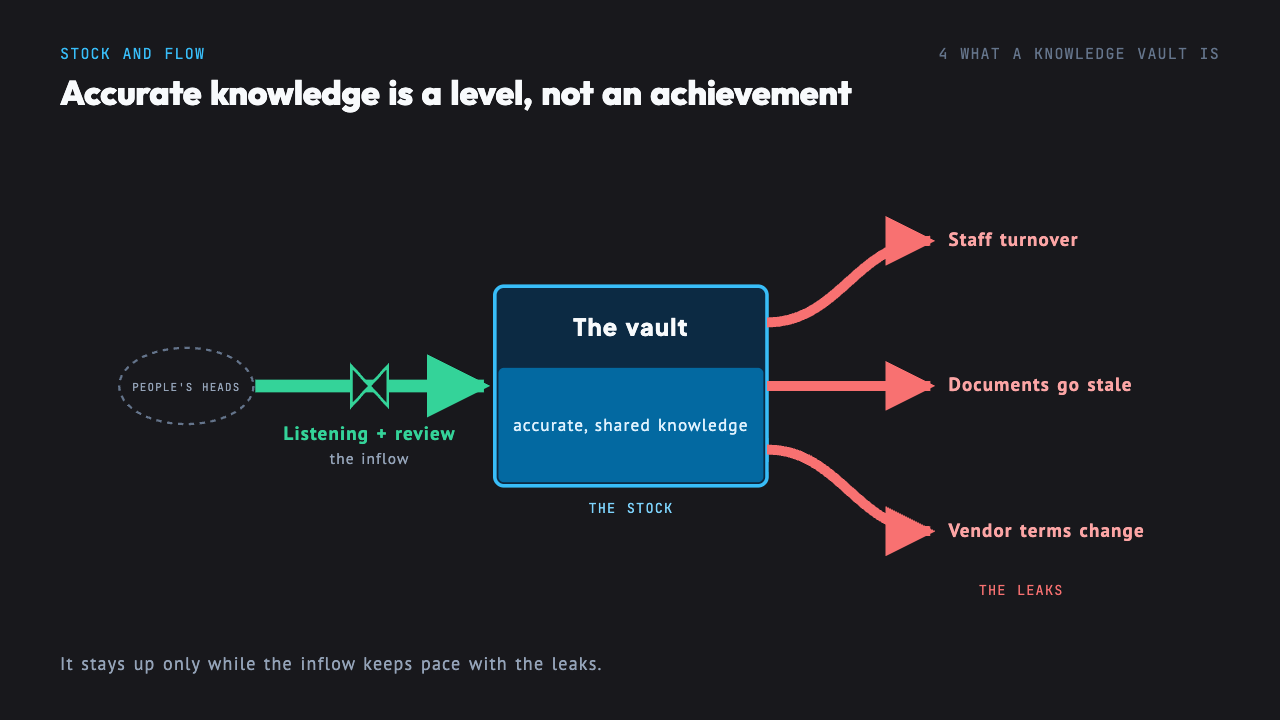
So the last part of my answer to Marian is a name. Who keeps listening after she's gone?
- APQC. (2025). The great retirement: Knowledge loss, AI and the workforce shift. https://www.apqc.org/resource-library/resource-listing/great-retirement-knowledge-loss-ai-and-workforce-shift-survey
- De Paoli, S. (2024). Performing an inductive thematic analysis of semi-structured interviews with a large language model: An exploration and provocation on the limits of the approach. Social Science Computer Review, 42(4), 997–1019. https://doi.org/10.1177/08944393231220483
- Feigenbaum, E. A. (1977). The art of artificial intelligence: I. Themes and case studies of knowledge engineering. In Proceedings of the International Joint Conference on Artificial Intelligence (IJCAI-77) (pp. 1014–1029). https://ijcai.org/Proceedings/77-2/Papers/092.pdf
- Ferreira, K. J., & Tong, J. (2026, September–October). How AI agents orchestrate work across silos. Harvard Business Review. https://hbr.org/2026/09/how-ai-agents-orchestrate-work-across-silos
- Frické, M. (2009). The knowledge pyramid: A critique of the DIKW hierarchy. Journal of Information Science, 35(2), 131–142. https://doi.org/10.1177/0165551508094050
- Lambe, P. (2017). Knowledge audits in practice: Report on global survey. https://www.greenchameleon.com/knowledge-auditing-and-mapping
- Liebowitz, J., Rubenstein-Montano, B., McCaw, D., Buchwalter, J., Browning, C., Newman, B., & Rebeck, K. (2000). The knowledge audit. Knowledge and Process Management, 7(1), 3–10. https://doi.org/10.1002/(SICI)1099-1441(200001/03)7:1<3::AID-KPM72>3.0.CO;2-0
- Malhotra, Y. (2004). Why knowledge management systems fail: Enablers and constraints of knowledge management in human enterprises. In Handbook on knowledge management 1 (pp. 577–599). Springer. https://doi.org/10.1007/978-3-540-24746-3_30
- Panopto. (2018, July 17). Workplace knowledge and productivity report [Press release]. PR Newswire. https://www.prnewswire.com/news-releases/inefficient-knowledge-sharing-costs-large-businesses-47-million-per-year-300681971.html