Ninety-six documents, twenty owners
When a donor cancels a monthly bank payment at one small nonprofit I consult with, three people have to notify each other by email. If one message is missed, the donor keeps getting charged, or the records say they're still giving.
No document shows this work. I found it by listening.
The system nobody used
One nonprofit has ten people. They sponsor children in several countries, and their work runs across a donor system, an accounting system, a payment gateway, a website, a shared drive and Slack. The first version of their knowledge system was the obvious one: an AI knowledge base connected to the shared drive.
Apart from our own testing at launch, it got a few questions in some weeks and none in most.
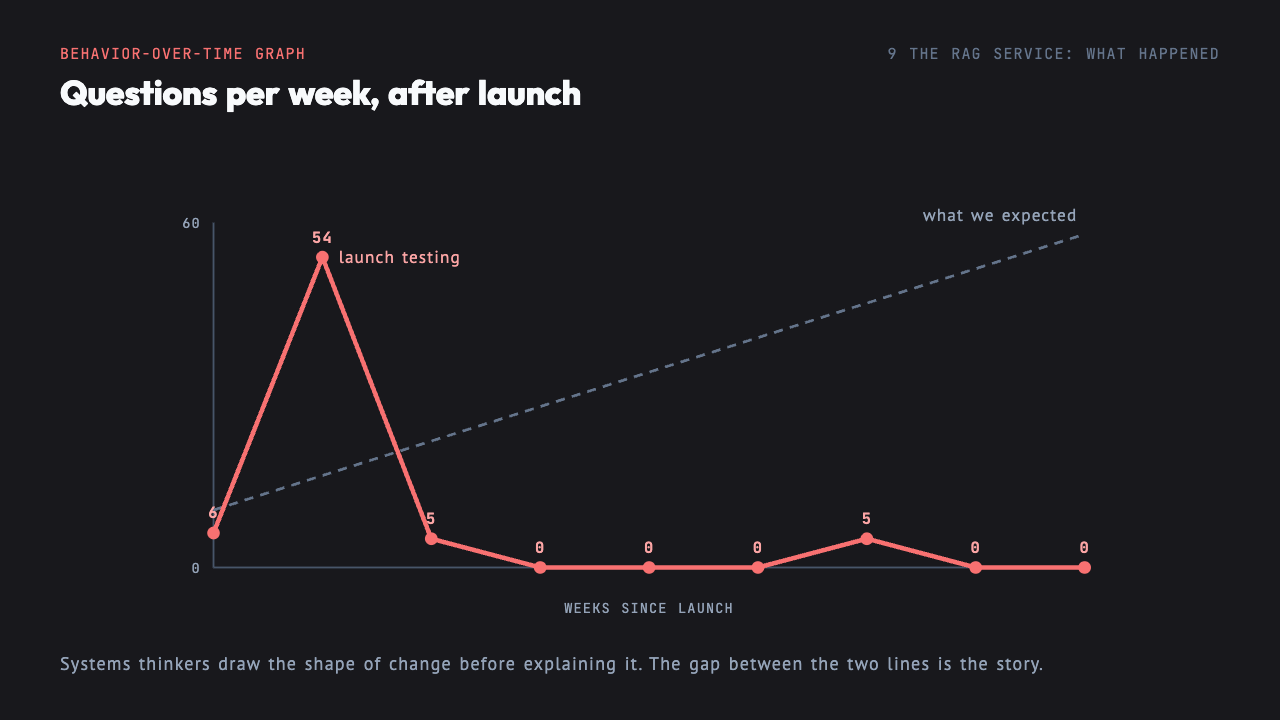
Low use isn't a failure on its own. Some knowledge vaults are only meant for one or two people, at the moment they need it. The idea isn't that the most people possible use a vault. It's that it gets used at the right time, when the knowledge is needed most.
But low use can also mean the system can't answer the questions people have. So we checked the documents. There were ninety-six. Twenty named an owner. Seventy-six were flagged as stale. The sync skipped PDFs and kept only the first 2,000 characters of every other file.
The system could answer "who does what." It couldn't answer "how does this actually get done."
Data, and the work underneath it
That gap has a name. It's the difference between data and knowledge.
The drive held data: policies, role descriptions, records, plans. Knowledge is know-how, how the work really runs, and most of it was never written down. Russell Ackoff called knowledge "know-how, for example, how a system works" (Ackoff, 1989, p. 4, as cited in Frické, 2009). Picture an iceberg. The small white tip above the waterline is what gets written down. Everything below it is what people actually carry: the workarounds, the handoffs, the judgment calls, the guiding principles, the tacit knowledge.
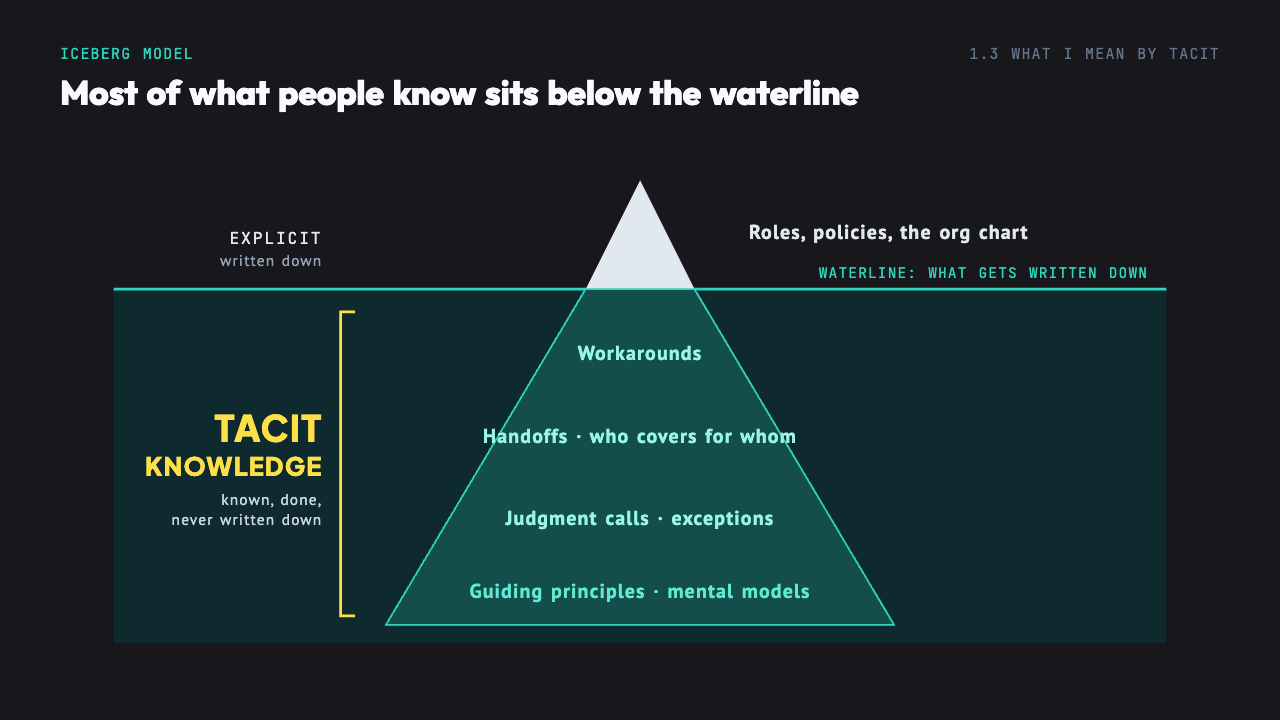
Knowledge management has spent three decades building systems for the tip. Intranets, wikis, portals, repositories. People were asked to fill them, and then mostly didn't come back. As early as 1999, Richard McDermott was reporting that leveraging knowledge "is more dependent on community building than information technology" (McDermott, 1999). An AI on top of the same documents inherits the same weak spot. Agents can only follow processes someone has written down clearly.
Listening from the ground up
So we started again from the bottom. That's what I mean by a ground-up knowledge audit.
A knowledge audit asks what an organization knows, what it needs to know, where that knowledge lives and where it fails. Knowledge management writers were calling it "one of the critical first steps" twenty-five years ago (Liebowitz et al., 2000). Most begin with an inventory of documents and systems. A ground-up audit begins with the people doing the work.
Every staff member had 1x1 listening sessions. Each session was transcribed, and each workflow became a short record in that person's words, linked to the moment it was said. Then each person reviewed their own records until they were accurate. That review matters more than it looks. Experts know more than they can recall in an interview. Seeing it written down brings out the corrections and the missing steps.
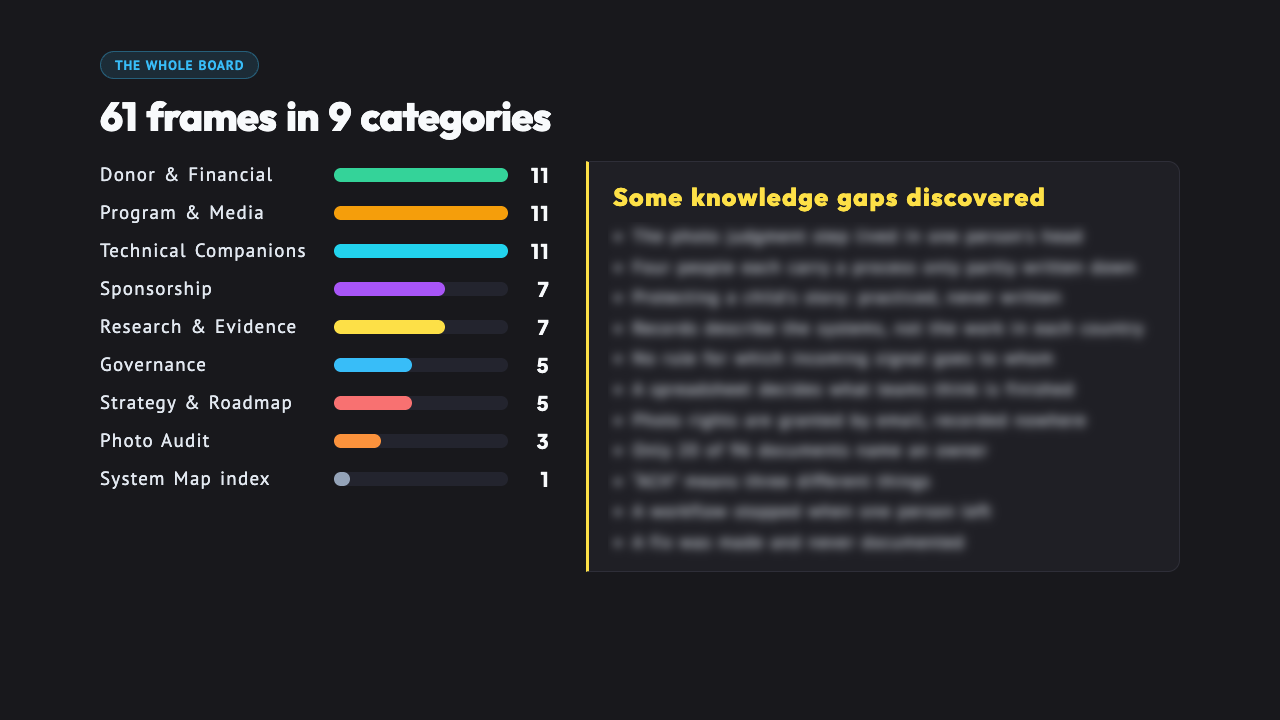
We ended with sixty-one records in nine categories, each signed off by the people who do that work. Some of what they show:
- The donor system and the accounting system don't talk to each other. People are the connection, matching the two by hand every week.
- Three times a year, one person looks at every child's photo before a sponsor sees it. Everything around that step can be automated. That step is kept human on purpose.
- "ACH" means three different things depending on who's talking.
- A workflow stopped when one person left.
- A fix was made and never documented.
Every one of those is operations know-how. None of it was in the ninety-six documents.
What AI did, and what it didn't
AI helped a lot, behind us. Capture got cheap. An hour of conversation became a transcript and a first-draft record in minutes, and agents could do much of the tedium of pulling quotes and proposing groupings. That used to be the expensive part: in Patrick Lambe's survey of knowledge auditors, interviews were valued "for their depth and richness" and known to be "time consuming to conduct and analyse" (Lambe, 2017).
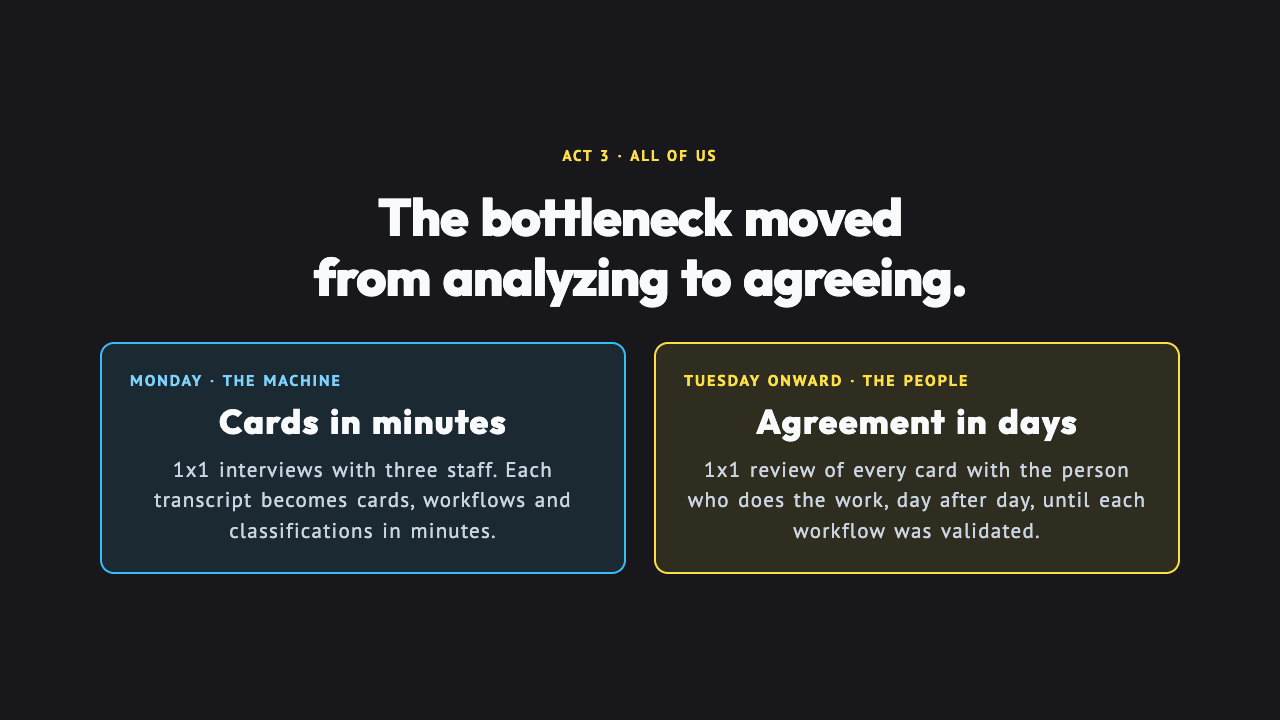
AI didn't decide what was true. The people did that, by reading their own records and correcting them. Checking is still the slow part. It's also the part that makes the knowledge worth trusting. Models also miss things. In one test on interview data, a model never surfaced themes that "clearly had value for human analysts" (De Paoli, 2024, p. 19).
In the new system, an agent reads plain files directly, with an index and a named owner on every page. That's a knowledge vault. If you want the old term, it's a knowledge base. What's different is how it was filled.
Why this matters past one nonprofit
Every organization has the same three moments where this knowledge either moves or disappears:
- Onboarding. New hires learn the job as listed, then learn the real version by trial and error.
- Cross-training. Covering for a colleague means rediscovering the workaround that keeps two systems in step.
- Retirement. Each retirement takes workarounds and judgment with it. In a 2025 APQC survey, "92% of organizations do not consistently capture knowledge from soon-to-be retirees" (APQC, 2025).
Writing in Harvard Business Review this fall, Kris Johnson Ferreira and Jordan Tong describe the same gap at company scale. Many companies now use AI to improve individual tasks, but "most still struggle to apply it to the cross-functional work that makes or breaks enterprise performance" (Ferreira & Tong, 2026). At the nonprofit, the donor system and the accounting system were joined only by people. That's what cross-functional work looks like from below the waterline.
A ground-up audit is how that knowledge gets from one person to the team, and from the team to the organization. It's not a one-time project, either. A vault fills only one way, through listening and review. It drains all the time, as people leave, documents go stale and vendors change terms.
I'll be honest about the hard part. It isn't the technology. It takes patience to work with leadership on a bottom-up audit, because it starts with the people at the bottom of the org chart, not the top. But if you don't do the ground-up work, you're not closing the gap. You're just putting a faster search box on the tip of the iceberg.
- APQC. (2025). The great retirement: Knowledge loss, AI and the workforce shift. https://www.apqc.org/resource-library/resource-listing/great-retirement-knowledge-loss-ai-and-workforce-shift-survey
- De Paoli, S. (2024). Performing an inductive thematic analysis of semi-structured interviews with a large language model: An exploration and provocation on the limits of the approach. Social Science Computer Review, 42(4), 997–1019. https://doi.org/10.1177/08944393231220483
- Ferreira, K. J., & Tong, J. (2026, September–October). How AI agents orchestrate work across silos. Harvard Business Review. https://hbr.org/2026/09/how-ai-agents-orchestrate-work-across-silos
- Frické, M. (2009). The knowledge pyramid: A critique of the DIKW hierarchy. Journal of Information Science, 35(2), 131–142. https://doi.org/10.1177/0165551508094050
- Lambe, P. (2017). Knowledge audits in practice: Report on global survey. https://www.greenchameleon.com/knowledge-auditing-and-mapping
- Liebowitz, J., Rubenstein-Montano, B., McCaw, D., Buchwalter, J., Browning, C., Newman, B., & Rebeck, K. (2000). The knowledge audit. Knowledge and Process Management, 7(1), 3–10. https://doi.org/10.1002/(SICI)1099-1441(200001/03)7:1<3::AID-KPM72>3.0.CO;2-0
- McDermott, R. (1999). Why information technology inspired but cannot deliver knowledge management. California Management Review, 41(4), 103–117. https://doi.org/10.2307/41166012